By the time Ed Pulaski found the mine tunnel, he was no longer trying to put out a forest fire.
He was trying to get men out of one.
The distinction had become fairly obvious by the afternoon of August 20, 1910. Smoke had made midday look like night. Trees were coming down in the wind. The scattered men Pulaski had collected along the ridges south of Wallace, Idaho, were laborers assembled for an emergency rather than a modern fire crew: timber cutters, miners and whoever else the young Forest Service had been able to hire. Many did not know the country. Pulaski did.
His own later account says he finally gathered forty-five of them. Current interagency reconstruction puts the number at roughly forty-five to fifty. Head counts made while people are running through smoke are allowed to be untidy.
Pulaski knew there was an old exploratory mine somewhere up Placer Creek.
That was where he took them.

An abandoned mine is not an especially reassuring wildfire safety plan.
Everything outside it was worse.
Five years old
The United States Forest Service had existed for only five years.
That matters because the organization confronting the fires of 1910 was not the agency we tend to imagine when we hear “Forest Service.” Supervisors in Idaho and Montana had a small professional staff, recently trained foresters, locally hired guards and labor gathered from mines, timber camps and towns.
The summer had been brutal. Fires had been burning across the West since spring. By August, drought had left the Northern Rockies exceptionally dry. The Forest Service was fighting so many fires that the federal government eventually sent thousands of soldiers to help.
Then, on August 20, powerful winds crossed the region and turned many separate fires into something much larger. Modern Forest Service research estimates that more than 2.65 million acres burned on August 20 and 21 alone. Broader historical estimates put the Big Burn above three million acres.

At least eighty-five people died. Most were firefighters.
Pulaski was about ten miles southwest of Wallace.
The wind took over
Pulaski published his own account thirteen years later in American Forestry after winning a Forest Service ranger-story contest.
That delay matters. It is a primary source because the man writing it was there. It is not a transcript made on August 21, 1910. Memory, reputation and thirteen years sit between the event and the page.
Still, the physical details in it are difficult to forget.
Pulaski remembered wind strong enough to threaten men in their saddles. Canyons funneled heat and smoke. Pack animals and supplies were abandoned. By shortly after noon it had become so dark that he struggled to make the men understand him. He told them to take blankets and follow.
There was also a bear.
Pulaski remembered one coming down the same burning trail and getting among the fleeing men and horses. Thirteen years later he wrote that he often wondered what happened to it.
That detail is almost useless to the heroic version of the story. Which is why I like it.
People remember odd things when the world stops behaving properly.
They were cut off downstream
The group started toward Wallace. Current NWCG reconstruction has Pulaski leading the men off Striped Peak into the West Fork of Placer Creek, then scouting ahead when they reached an old cabin. Fire had blocked the downstream route. He turned them back up canyon toward the mine opening now known as the Nicholson adit, or Pulaski Tunnel.
Pulaski’s 1923 account says one man was killed by a falling tree before the others reached the mine. They had barely entered when fire crossed the trail behind them.
Inside, Pulaski ordered everyone onto the floor. They soaked blankets and hung them across the opening. The mine had water in it, which suddenly became more valuable than whatever mineral somebody once hoped to remove from the place.
Pulaski filled his hat from that water and threw it against the blankets and burning timbers.
Then the blankets caught fire too.
The gun
This is where the story becomes legend.
A man tried to leave.
Pulaski says he drew his revolver and threatened to shoot the first man who tried to leave the tunnel. He also says he never had to use it.
I would keep the gun in the article because Pulaski himself put it there. I would not narrate the sentence as independently verified dialogue from August 20.
The wording comes from his 1923 prize-winning recollection. That is strong evidence that Pulaski told the story this way. It is weaker evidence that every word was spoken exactly that way thirteen years earlier.
The distinction costs us almost nothing. The mine was still full of men who thought running outside might be better than staying inside while the timbers burned.
Pulaski kept them there.
The air stopped working
Heat and smoke entered despite the blankets. So did what Pulaski called “fire gas.” Men began losing consciousness. Eventually Pulaski did too.
At some point late in the night, one man recovered, got out and made his way toward Wallace. He reported that he was the only survivor.
He was wrong.
Around five in the morning, according to Pulaski, air began circulating through the mine again.
Men woke. Their legs would not hold them. They crawled toward Placer Creek expecting water and found the stream choked with ash and too warm to drink.

That may be the detail I would leave longest on the page.
They had survived the fire.
The creek was warm.
The count
Pulaski says they counted the men.
Five inside the tunnel were dead.
Combined with the man he said had been killed by a falling tree during the run to the mine, his own narrative therefore accounts for six deaths from the group he had gathered.
Historical shorthand has not handled that cleanly. Some modern summaries say all but five survived. The University of Idaho photograph of the tunnel carries old text saying six died “here,” although Pulaski’s account puts one of those deaths on the trail before they arrived.
I do not think the article improves by picking whichever number produces the neatest sentence.
The safest formulation is that Pulaski led roughly forty-five men toward the tunnel, one died during the retreat, five more were dead by morning, and roughly forty survived the episode.
The conflicting counts are part of the source record, so the article should leave them visible rather than force them into one number.
Wallace
Pulaski could not see. His hands were burned. Shoes had burned away from feet. Clothing had become rags. The survivors staggered and sometimes crawled over smoking debris toward Wallace until a rescue party reached them.

Roughly a third of the city had burned. Contemporary photographs show blocks reduced to brick piles, twisted sheet metal and freestanding walls with nothing behind them.
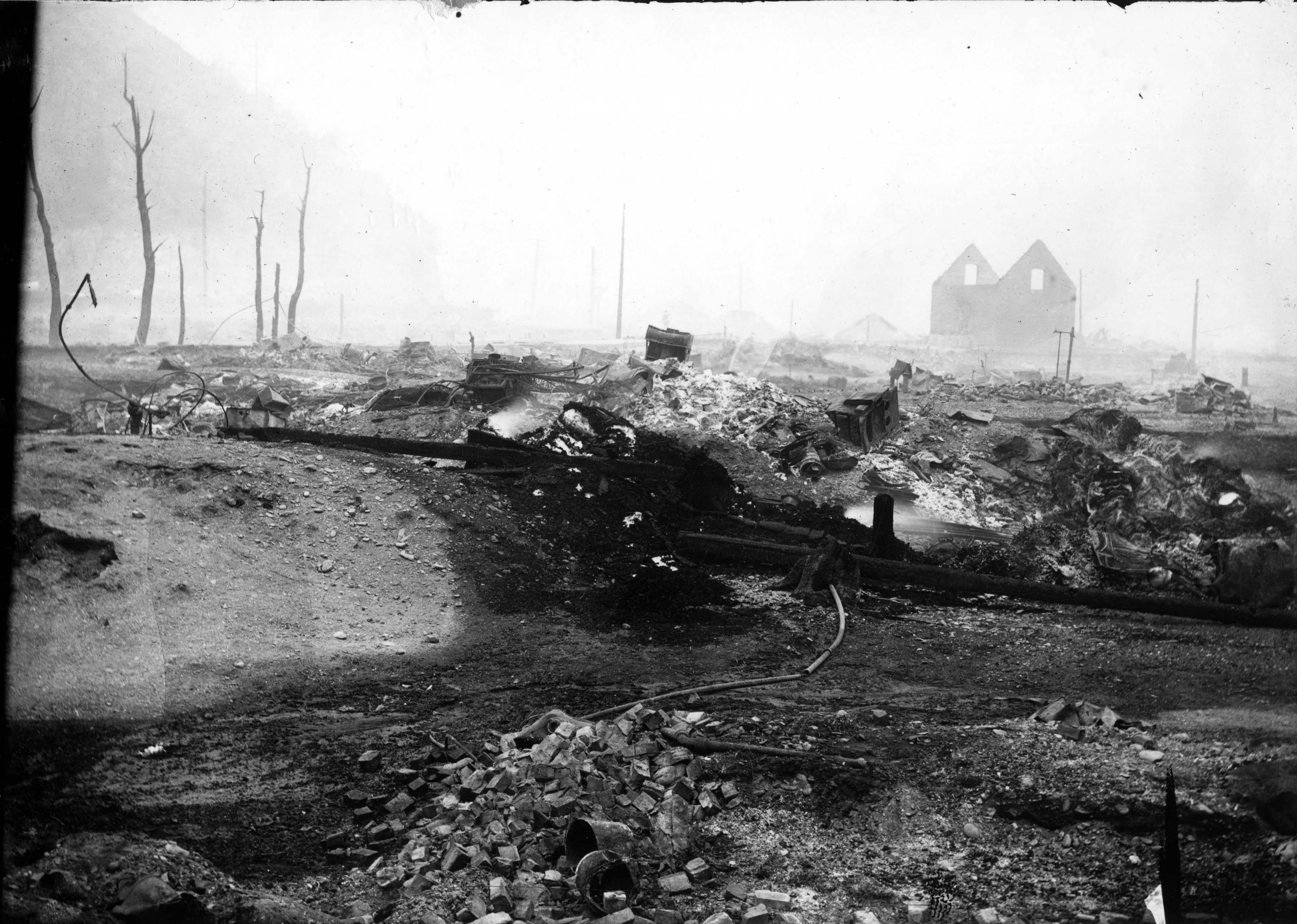
Pulaski reached medical care. Then he insisted on going home.
Because he was blind, another man had to lead him there. Pulaski wanted to know whether his wife and young daughter had survived the fire that had burned part of Wallace.
They had.
He was sent back to the hospital and stayed there for nearly two months with blindness and pneumonia. His eyesight returned, but he wrote years later that the fire had left him with damaged eyes, lungs and throat.
How Pulaski became the story of 1910
Pulaski became one.
That is understandable. A young federal agency had just suffered a national catastrophe. Pulaski gave it a human story that could be told in a few sentences: ranger knows terrain, finds mine, controls panicked crew, nearly dies saving them.
Most of that story is true. The problem comes when the neat version starts replacing the historical one.
He was credited with developing the combination firefighting tool that still carries his name: axe blade on one side, narrow trenching blade on the other. The origin story is less important here than the odd persistence of the name. A man from one fire became a tool firefighters still carry to other fires.
The 10 a.m. policy came later
There is another piece of Big Burn history that gets compressed too aggressively.
You will sometimes see the 1910 fires described as the event that created the Forest Service’s 10 a.m. policy—the rule that fires should be controlled by 10 a.m. the day after they were reported.
The dates do not work.
The Big Burn profoundly strengthened the agency’s commitment to total fire suppression, but the formal 10 a.m. policy came in 1935, after additional severe fire seasons and a quarter-century of institutional development.
What 1910 did was earlier and probably more important. It convinced a generation of Forest Service leaders that catastrophe had occurred because they had lacked enough people, equipment and authority to extinguish fires quickly enough. The idea that fire should be eliminated from the landscape became deeply embedded in Forest Service policy.
There were people arguing the other side even then. Some foresters and land managers pointed out that low-intensity burning could reduce hazardous fuels. The argument would take decades to come back.
A century without enough fire
Modern land management has moved considerably. USDA now describes fire as a fundamental ecological process in many American ecosystems and explicitly includes prescribed fire and, where conditions permit, managed wildfire among tools for restoring fire-adapted landscapes and reducing hazardous fuel accumulation.
That leaves modern fire managers with a harder problem than the old suppression rule allowed. Some fires demand immediate attack because people and infrastructure are at risk; others can be tolerated or used when conditions make that safe. The difficult part is deciding which situation you are in before conditions change.
Firefighters still go back into the tunnel
Pulaski’s story has not been retired into a museum display.
The National Wildfire Coordinating Group maintains a full 1910 Fires Staff Ride around Wallace. Modern firefighters study Pulaski’s route, the Nicholson adit, weather, crew cohesion, accountability, entrapment and the decisions made as escape routes disappeared.
There is a natural Final Vestige connection here to The Fire He Lit Himself, about Wag Dodge and Mann Gulch in 1949.
The two stories are separated by thirty-nine years. Pulaski survived because he knew about a hole already in the mountain. Dodge survived because, with the fire overtaking his smokejumpers, he created an escape fire and lay inside the area it had already burned.
Both events are now studied because knowing the ending does not make the decisions easy.
The photograph has the wrong number too
There is a 1910 photograph of the tunnel in the University of Idaho archive. Two men sit at its entrance beneath rough timber supports. Burned logs and broken material lie around them.
The old caption written onto its record says that six men died there.
That is not quite what Pulaski said. He put one death on the trail before the tunnel and five inside by morning.
I would publish the photograph anyway. In fact, I like it more because of the disagreement.
Historical images are evidence. Their captions are evidence too. Neither is automatically the last word.
The way out

The mine opening survived. The Forest Service did too.
One is easier to recognize than the other.
The agency that came out of 1910 spent much of the twentieth century becoming extraordinarily good at finding fires and putting them out. Modern fire management is now partly occupied with undoing some of the ecological consequences of doing that too successfully for too long.
Pulaski’s own legacy is less abstract. A trail south of Wallace still leads toward the Nicholson adit. Firefighters still study what happened there. A hand tool still carries his name.
The tunnel was never built as a fire shelter.
On August 20, 1910, it was simply the piece of geography Pulaski knew about that the fire had not taken yet.
The way out was underground.
Sources & Further Reading
The strongest source base combines Pulaski’s own later recollection with Forest Service/NWCG operational reconstruction, institutional forest-history scholarship and modern fire-ecology guidance.
- E. C. Pulaski, “Surrounded by Forest Fires,” American Forestry, August 1923. Pulaski’s first-person account of the retreat, mine, revolver episode, burning blankets, deaths and his injuries. It was written thirteen years after the event, which matters when handling exact dialogue.
- National Wildfire Coordinating Group, 1910 Fires Staff Ride. The strongest current operational reconstruction of Pulaski’s route, the Nicholson adit and the decisions made as escape routes disappeared.
- Forest History Society, “The 1910 Fires.” Institutional synthesis of the young Forest Service, fire scale, Pulaski legend and the policy aftermath.
- University of Idaho Library, Big Burn Collection. Primary visual and documentary archive of Wallace, Placer Creek and the 1910 fires.
- University of Idaho, “Pulaski at Pulaski Tunnel.” Public-domain 1910 photograph whose inherited caption provides a useful example of the five-versus-six casualty ambiguity.
- Library of Congress, 1905 Sanborn Fire Insurance Map of Wallace. Public-domain urban map showing Wallace before the fire altered it.