Near the end of the run for the ridge, Wag Dodge stopped.
The fire was behind him. The ridge was still above him. Men were running uphill through grass and loose rock, carrying what was left of their strength after a long afternoon in record heat. Dodge had already ordered them to throw away their tools. By his later estimate, the main fire was perhaps fifty yards away when he did something that must have looked insane to at least some of the men coming past him.
He struck a match. Then he set the grass in front of him on fire.

The idea was simple once you understand it. Let the small fire consume the grass first. Wait for it to burn down. Step into the black. When the much larger fire arrived, there would be less fuel immediately around you.
Dodge tried to explain this to the men close enough to hear him. The National Wildfire Coordinating Group’s reconstruction says no fewer than eight were nearby. About one hundred square feet had burned when the others continued toward the ridge. Dodge stayed behind, entered the burned patch and lay down.
The crew had not been trained to recognize an escape fire, and Dodge had only seconds to explain what he was doing.
A small fire
Mann Gulch sits in rough country about twenty miles north of Helena, where a narrow drainage runs toward the Missouri River. A lightning storm crossed the area on August 4, 1949. The fire was spotted the following day, during unusually hot conditions, and District Ranger Robert Jansson requested smokejumpers because getting a ground crew into the country quickly would be difficult. Fifteen smokejumpers eventually parachuted in, joining James Harrison, a Forest Service fire guard already working the fire.

At roughly 3:10 that afternoon, the fire looked to Dodge and the jump crew like something on the order of sixty acres.
The men did not jump into an obvious inferno. The fire appeared manageable enough that the crew expected to have it lined and under control by the following morning. The smokejumper program was still young, but it already carried a strong reputation for aggressive initial attack: get people onto a remote fire quickly, catch it while it is still small, move on to the next one.
The cargo drop did not go cleanly. Heavy turbulence scattered equipment, and the crew’s radio broke when it hit the ground. By the time the men had collected what they could, it was close to five o’clock. Survivor Robert Sallee later recalled looking at the fire and deciding it did not seem particularly bad.
That judgment looks terrible when read backward from the deaths. It makes more sense if you stay at five o’clock.
The river
Dodge met Harrison near the fire and decided the ridge where Harrison had been working was not a good place to attack it. The plan became to move toward the Missouri River, where the crew expected to find safer ground and a better place to work from the upwind side.
The weather was already changing the geometry. Later Forest Service reconstruction found that winds had shifted during the afternoon. Jansson, working his way into the mouth of Mann Gulch, estimated winds there around twenty to thirty miles per hour, with gusts perhaps reaching forty. Canyon shape and ridges could make those winds behave differently from the measurements recorded in Helena.

Dodge and Harrison caught the rest of the crew at about 5:40. Five minutes later, the route to the river was gone. Firebrands had started spot fires below the men on their side of the gulch. Those fires were growing rapidly enough that continuing downhill toward the Missouri no longer looked possible. Dodge turned the crew around and sent them back uphill.
The exact mechanism by which the fire crossed and accelerated through the gulch is one of the places where the historical record should stay untidy. Later researchers considered thunderstorm downdrafts, fire whirls and the interaction of strong winds with the canyon terrain. Richard Rothermel’s 1993 Forest Service reconstruction explicitly warned that its precise-looking times and locations were estimates, not measurements recorded while the event was happening.
I like that warning. A map made forty-four years afterward can put a line exactly where the fire probably was at 5:53. The fire did not know about the line.
Drop the tools
By about 5:53, Dodge told the men to throw away their heavy equipment.
Investigators later found the discarded tools concentrated in roughly the same area, good evidence that the crew was still together at that point. Dodge remembered the fire being perhaps seventy-five to one hundred yards behind them. Rothermel’s reconstruction puts the advancing fire roughly a minute away.
The terrain was getting worse for the people and better for the fire. The men were climbing through steep ground with poor footing. As the timber thinned, the fuels became lighter and more exposed to the wind. That sounds like an improvement until you look at what dry grass does when wind gets hold of it.
Rothermel estimated the fire could have accelerated from roughly 170–280 feet per minute farther down the escape route to somewhere between 360 and 610 feet per minute as the crew reached more open ground. Near the final section of the run, his model produced rates around 600–750 feet per minute under the reconstructed conditions.
Those numbers should not be treated like stopwatch readings from 1949. Rothermel said as much. The useful point is the relationship: the men ran faster, and the fire accelerated faster than they did.
The second fire
At around 5:55, Dodge stopped. The main fire was now so close that, under Rothermel’s reconstruction, it could cover fifty yards in somewhere around fifteen to thirty seconds.
Dodge lit the grass.
NWCG today describes what he was trying to do as an emergency survival technique that the smokejumpers had not been trained to use. His intention was to burn away the fuels, let the patch cool enough to enter and then remain inside it while the main fire passed.
The ridge was still visible, while Dodge’s new fire required an explanation he barely had time to give.
The notch
Two men found another way. Walter Rumsey and Robert Sallee climbed directly toward the rimrock above them. The ridge was edged by rock that in places stood six to twelve feet high, but it was broken by occasional crevices. Sallee and Rumsey found one and worked through it.
Rumsey was exhausted enough after reaching the top that Sallee had to get him moving again. They eventually took shelter among rocks beyond the ridge.
Another jumper reached the base of the rimrock but did not make it through the same opening. William Hellman reached the ridge badly burned and died the following day. Joseph Sylvia also survived the immediate burnover but died after being evacuated. Eleven others were found dead in the gulch.
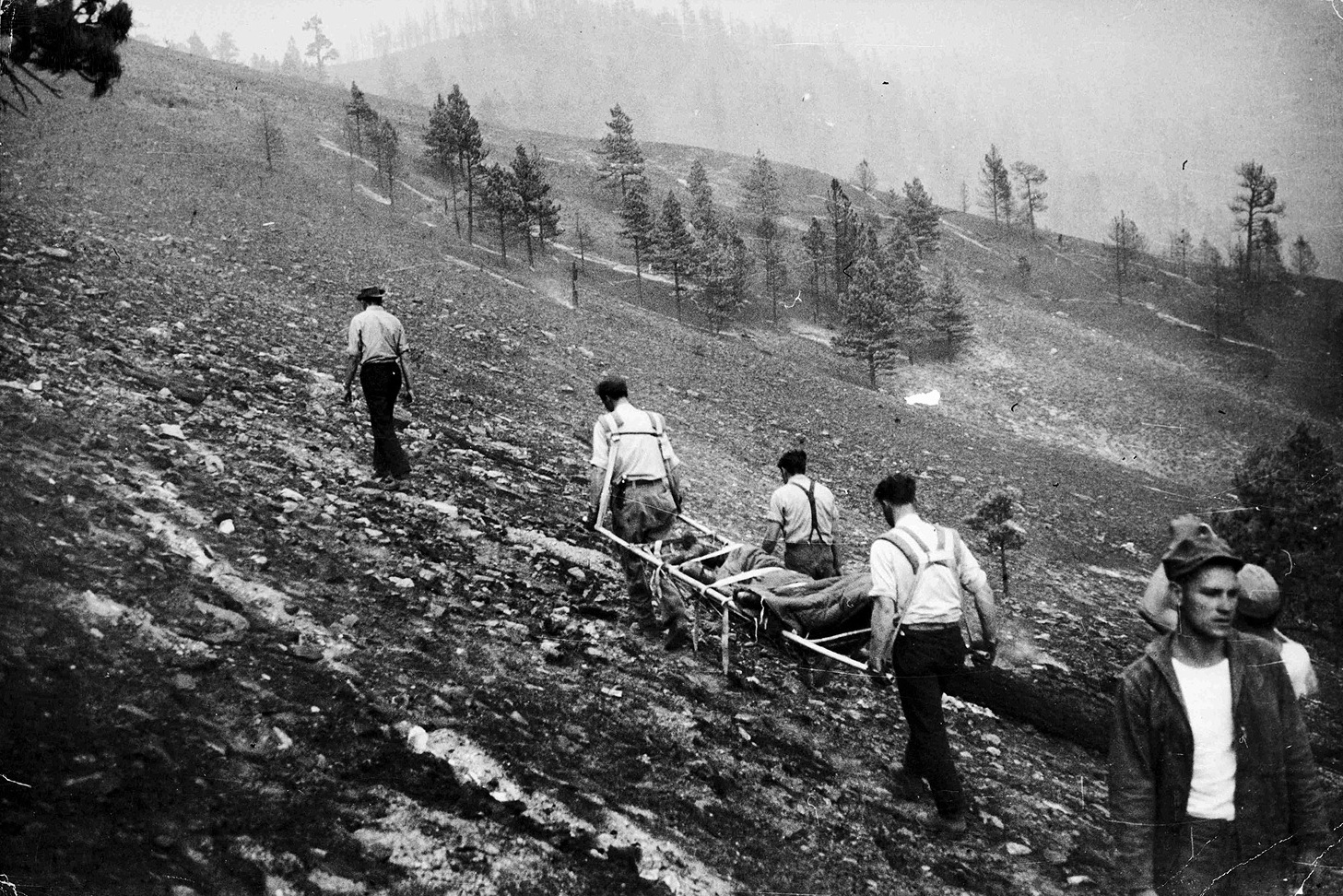
Dodge survived in the patch he had burned. Rothermel’s later account says the grass burned away quickly enough to leave a fuel-free area around him. Dodge reported fierce winds while the main fire passed over and around the site. By about 6:10, he could sit up and move among the remaining pockets of fire.
Thirteen firefighters ultimately died: twelve smokejumpers and James Harrison.
The argument afterward
Dodge’s escape fire did not immediately enter history as an uncomplicated stroke of genius. There was controversy over whether the fire he set might actually have contributed to the deaths. The Forest Service Board of Review investigated the decisions and fire behavior, and the question continued to follow the incident into later research. Rothermel’s 1993 work specifically identified whether Dodge’s escape fire had overtaken his crew as one of the unresolved questions researchers were still trying to reconstruct decades later.
The problem was larger than Dodge
The Forest Service could have remembered Mann Gulch mainly as an extraordinary act of improvisation. Instead, the disaster became part of a much larger change in how the agency studied fire.

The current Forest Service traces the creation of the Missoula Fire Sciences Laboratory directly to the need for better understanding after Mann Gulch. The Northern Forest Fire Laboratory was dedicated in 1960 with facilities that included a sixty-six-foot combustion chamber, allowing researchers to study fire behavior under controlled conditions rather than waiting for another canyon to provide the experiment.
Richard Rothermel eventually worked there. His later mathematical fire-spread model became one of the foundational tools used in wildland fire behavior prediction. The strange loop is hard to miss: the laboratory created in the aftermath of Mann Gulch eventually produced the science used to reconstruct what probably happened at Mann Gulch.
The institutional response also became procedural. In 1957, a Forest Service task force reviewed sixteen fatality fires from the previous two decades and developed the original Ten Standard Firefighting Orders. Mann Gulch was among the incidents informing that work. The current orders still require firefighters to keep informed about fire weather, know what the fire is doing, base actions on expected behavior, identify escape routes and safety zones, maintain communications and provide for safety before aggressive suppression.
I would be careful about claiming every sentence on that list was written because thirteen men died in Montana. It was not. The task force studied many fires. Mann Gulch was one of the cases that made the need difficult to ignore.
Before the fire arrives
There is a natural comparison here with Final Vestige’s The Rescue Machine Nobody Had Ever Needed.
When Squalus sank in 1939, the Navy already possessed a rescue system before the submarine went down. The equipment was strange, specialized and largely untested in a real catastrophe, but the people operating it shared an understanding of what it was supposed to do.
Mann Gulch shows the opposite condition. Dodge found a survival solution with the emergency already closing the distance. His men had never been trained to recognize it. By the time he needed them to understand, there were seconds.
Later wildland firefighters inherited something different: formal fire-behavior research, designated safety zones, survival training, fire shelters and standardized orders intended to put certain ideas into crews before they need them. Rothermel made exactly that contrast when he compared Mann Gulch with the 1985 Butte Fire, where seventy-three trapped firefighters used prepared safety zones and fire shelters and all survived the burnover.

The place where he stopped
Mann Gulch is still used for training.
NWCG runs a formal staff ride there, taking firefighters and leaders through the landing area, the turnaround, the tool drop, the escape-fire site and the ridge where Sallee and Rumsey got out. The purpose is explicitly not to stand on the slope decades later and announce which dead man made the wrong decision. Participants are asked to work through what people knew when they had to act.
At one of those stops is the place where Dodge stopped running. The crew had dropped its tools only minutes earlier. The fire was coming through the grass. The ridge was still above them.
Dodge took out his matches and burned the ground where he intended to stay.
Today, firefighters go there to learn what happened.
That small patch of ground became a classroom.
Sources & Further Reading
- U.S. Forest Service, Report of Board of Review: Mann Gulch Fire, Helena National Forest—August 5, 1949 (1949). The contemporary agency investigation and foundational primary record.
- Richard C. Rothermel, Mann Gulch Fire: A Race That Couldn’t Be Won (1993). The essential scientific reconstruction of the final minutes, rates of spread and escape routes, with unusually careful discussion of uncertainty.
- National Wildfire Coordinating Group, Staff Ride to the Mann Gulch Fire. Current professional training material built around the terrain, chronology and decision points.
- U.S. Forest Service, Mann Gulch History. Institutional treatment of the tragedy’s connection to modern fire-behavior research and the Missoula Fire Sciences Laboratory.
- NWCG, Origin of the 10 and 18. Documents the 1957 task force that studied fatality fires and developed the original Ten Standard Firefighting Orders.