The machine was supposed to find uranium.
Late on January 26, 1978, it was bolted into a Canadian Hercules flying over the frozen eastern end of Great Slave Lake. Below was an enormous amount of white, interrupted by dark spruce, exposed rock and the occasional human settlement. Somewhere in that landscape might be pieces of a Soviet spacecraft that had broken apart over Canada two days earlier.
The instrument began seeing something that did not belong.

At 10 p.m. Eastern time, the crew reported the first radioactive “hit” around McLeod Bay, north of Fort Reliance. Another aircraft carrying American detection equipment was sent across the area on a tight grid and confirmed that there was a real source below. The Geological Survey of Canada now identifies this as the first airborne detection of radioactive debris from Cosmos 954.
What interests me is who found it.
Not a satellite-tracking system.
Not an intelligence sensor designed to hunt Soviet spacecraft.
Geologists.
And the machine inside their aircraft had spent most of its life looking at rocks.
A better Geiger counter
Canadian geologists had been looking for radioactive minerals from the air since the middle of the twentieth century. Early surveys were fairly blunt instruments. A detector could tell you that radiation had increased beneath the aircraft, which was useful if you were looking for uranium, but it told you considerably less about exactly what had produced the signal.
By the late 1960s, Geological Survey scientist Quentin Bristow and his colleagues were developing something more discriminating.
Large sodium-iodide detectors could measure gamma radiation across an energy spectrum. Naturally occurring uranium, thorium and potassium produced identifiable signatures. Instead of merely asking whether the ground was radioactive, the instrument could begin asking what kind of radioactivity it was seeing. By 1970, a Survey system was flying routine geological missions from a Skyvan.

The team kept improving it.
The version used in 1978 recorded the full gamma spectrum. That turned out to matter enormously because northern Canada was not radiologically blank to begin with. The bedrock itself contained naturally radioactive elements.
The instrument had to find an artificial signal inside a natural one.
The Survey scientists were unusually well prepared for that problem. They had more than ten years of experience measuring natural radioactivity in harsh northern environments, including terrain inside what would become the Morning Light search zone.
Nobody had built the machine expecting it to identify pieces of a Soviet reactor.
It happened to know the difference between the reactor and the rocks.
The thing that fell
Cosmos 954 had been launched by the Soviet Union on September 18, 1977.
It belonged to a class of radar ocean-reconnaissance satellites used to locate and track naval forces. American Department of Energy historical material identifies the mission more specifically as monitoring U.S. Navy aircraft carriers. Radar powerful enough to perform that work from the satellite’s low orbit required more electricity than practical solar systems of the period could conveniently supply, so Soviet RORSAT spacecraft used compact nuclear reactors.
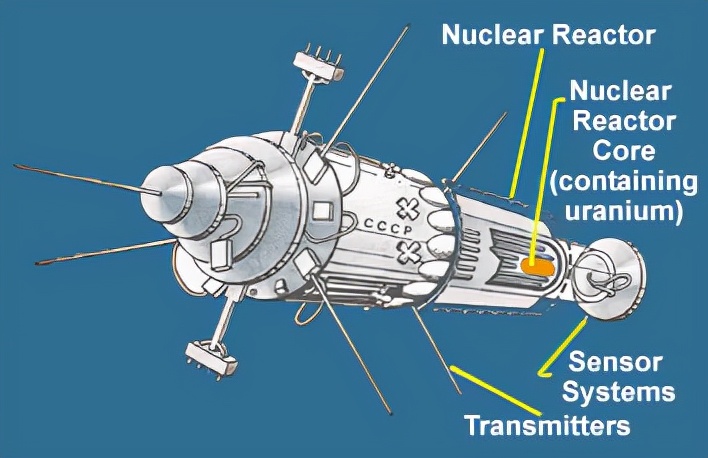
That arrangement worked only as long as the spacecraft remained where it belonged.
Soon after launch, NORAD detected trouble in Cosmos 954’s orbit. By December, its motion was clearly abnormal. American observers could eventually narrow the timing of re-entry reasonably well, but predicting where a decaying satellite would actually come down was another matter. The possible impact geography remained enormous.
On January 24, the answer arrived over Canada.
A Royal Canadian Mounted Police corporal at Hay River reported what looked like a meteor. Farther north, a janitor in Yellowknife saw bright objects moving across the predawn sky. Cosmos 954 was coming apart in the atmosphere above the Northwest Territories.
There were no reported human injuries from the re-entry. That is worth saying plainly because “nuclear satellite crashes into Canada” invites a considerably larger disaster in the imagination than the evidence supports.
The absence of injuries did not make the debris harmless.
Some of it was intensely radioactive.
And nobody yet knew where most of it was.
Morning Light
The Canadian and American response became Operation Morning Light.
Hundreds of Canadian military personnel, government specialists and support staff were joined by a 120-person American Nuclear Emergency Search Team. For NEST, this was its first foreign deployment. Aircraft came from both countries. Search operations eventually included large fixed-wing radiological surveys, helicopters flying lower and slower, ground teams with portable detectors and an extensive logistics system supporting people working through an Arctic winter.

Nothing about the ground operation was particularly simple.
The projected footprint stretched for hundreds of miles. Search aircraft required navigation references over a landscape in which one square mile of snow could look remarkably similar to the next. Microwave ranging transponders were positioned beneath recognizable landmarks and then moved as the operation progressed beyond their useful range. DOE photographs show technicians in heavy Arctic clothing walking detector sweeps over the snow after aircraft had narrowed a location enough to make that worthwhile.
The operation was built in layers.
Find an anomaly from high altitude.
Fly it again.
Narrow the coordinates.
Send a helicopter.
Then put people onto the ice and find out what the detector had actually found.
Sometimes the thing at the end of that chain was a piece of spacecraft.
Sometimes it was just radioactive geology.
That is why the geologists mattered.
The first hit
On January 26, the Canadian Department of Energy, Mines and Resources installed its radiation-detection system aboard a Hercules.
At 10 p.m., the McLeod Bay signal appeared.
The original American operational history calls it the first airborne hit. The Geological Survey’s current history describes the same event as the first identification of radioactive satellite debris, on frozen Great Slave Lake roughly 43 kilometers northwest of Fort Reliance.
The full-spectrum instrument gave the crew something more useful than a higher count rate.
The signal did not look like the ordinary uranium, thorium or potassium beneath the airplane.
It looked manufactured.
A second aircraft crossed the area with American detection equipment and confirmed the anomaly. Additional hits followed. By January 28, search aircraft were identifying debris around McLeod Bay with enough confidence to begin turning an astronomical uncertainty into actual points on a map.
There is a small human detail in the same federal report that prevents this from becoming merely an interesting story about sensors.
Officials were also trying to locate everyone living inside the search area.
By January 28, authorities believed they had identified the civilians who might be exposed and were trying to warn them. That afternoon came word that two men wintering at Wardens Grove, roughly 200 miles northeast of Fort Reliance, had already found and touched an unfamiliar object on the ice of the Thelon River.
The satellite had fallen into a remote place.
Remote is not the same thing as empty.
Things that looked ordinary
Cosmos 954 did not leave one recognizable wreck.
Searchers recovered plates, rods, cylinders, pipe sections and particles. Some objects looked sufficiently unremarkable that the radiation detector was the only obvious reason not to pick them up.
DOE’s later summary says approximately 100 radiological objects were collected, from microscopic material to large pipe sections. Some recovered pieces produced radiation fields ranging up to 200 roentgens per hour.

That number needs context more than drama.
A highly radioactive object is not the same thing as a vast contaminated landscape delivering that dose to everyone within it. Intensity changed enormously with distance, object, exposure time and location. Searchers therefore treated individual fragments as point hazards, locating them remotely when possible and recovering them under radiological controls.
The operation became as much a problem of sorting as finding.
The landscape already contained radioactivity.
A detector could see both.
The job was to decide which signal had been sitting in Canadian rock for geological time and which had arrived from orbit on Tuesday morning.
The percentages do not agree
This is where the official story develops an awkward numerical problem.
Health Canada’s current Cosmos 954 history says the Atomic Energy Control Board estimated that the operation recovered about 0.1 percent of the satellite’s power source.
A 2013 U.S. Department of Energy/NNSA history says something very different: that teams recovered more than 90 percent of the radioactive material in the reactor inventory.
Those figures are so far apart that repeating either one without qualification creates a false sense of certainty.
The wording is not identical—“power source” and “radioactive material in the reactor inventory” may involve different estimates and denominators—but the published government accounts do not reconcile the discrepancy for the reader.
A primary DOE scientific paper from the period makes the picture messier still. Its authors wrote that the reactor core itself was never found and proposed two broad possibilities for the missing fuel: some could have ended up beneath ice or water, while some had burned up during atmospheric re-entry.
I cannot make 0.1 percent and more than 90 percent become the same number from the official material available.
So I would not try.
What can be said securely is that the teams recovered many substantial radioactive components and particles, while a significant part of the fuel did not turn up as an intact reactor core on the Canadian ground.
Then scientists went looking somewhere else.
Thirty-nine kilometers up
The search eventually left Canada’s surface.
Scientists at the U.S. Department of Energy’s Environmental Measurements Laboratory suspected that some of the reactor material had ablated into extremely small particles high in the atmosphere.
They launched special balloons carrying high-volume filter samplers.
The filters went as high as 39 kilometers.
Back in the laboratory, researchers used a wonderfully indirect method to search the filters for enriched uranium. Pieces of filter material were placed against Lexan plastic and irradiated with neutrons. Uranium-bearing particles containing enough U-235 underwent fission and left tiny tracks in the plastic. After chemical etching, those tracks appeared as small star-like patterns under a microscope.
It was possible to identify quantities of uranium measured in nanograms.
The researchers eventually detected subnanogram quantities of Cosmos 954 uranium in filter material collected at 39 kilometers over Alaska. Their conclusion was careful: the evidence supported the idea that at least some of the satellite had burned up in the stratosphere.
The search had begun with airplanes looking down at Great Slave Lake.
Now balloons were looking for the satellite above the weather.
The geology machine went back to work
The Geological Survey spectrometer did not become a dedicated satellite-hunting device afterward.
That is probably the right ending for the machine.
The improved full-spectrum system returned to geological work. For roughly the next twenty years it helped map natural radioactivity in support of geological mapping and mineral exploration, and the Survey credits the program with helping establish international standards for airborne gamma-ray spectrometry.
Morning Light had been a strange interruption in a much longer scientific program.
The reason the interruption worked was that the Survey had not improvised its expertise after Cosmos 954 fell. Scientists already knew the instrument, the northern terrain and the natural radioactive background. They had spent years learning what Canadian rocks looked like in gamma rays.
When the sky added something new, they could see the difference.
Who pays for something falling from space?
Cosmos 954 also landed in a legal system that had been written before the accident.
The United Nations Liability Convention had entered into force in 1972. Article II makes a launching state absolutely liable for damage caused by its space object on the surface of the Earth. Canada therefore did not have to invent the basic principle of Soviet responsibility after the satellite came down.
The practical application was less automatic.
Canada and the Soviet Union spent years negotiating the claim. On April 2, 1981, the governments signed a protocol in Moscow under which the Soviet Union agreed to pay Canada C$3 million in full and final settlement of matters connected with the disintegration of Cosmos 954.
The accident did help push space law farther.
Canada raised nuclear-powered satellites before United Nations space committees almost immediately after the re-entry. An official UN analysis published decades later says the Principles Relevant to the Use of Nuclear Power Sources in Outer Space were negotiated in the wake of Cosmos 954, and that issues raised during the Canadian-Soviet settlement became a blueprint for much of their structure. The General Assembly eventually adopted those principles in 1992.
That is different from saying Cosmos 954 created space liability law.
It did not.
It forced existing law to deal with radioactive pieces of an intelligence satellite scattered across another country.
Canada did not have one office for this
The institutional problem on the ground was equally basic.
Health Canada’s present history says that, when Cosmos 954 fell, no single Canadian federal department had responsibility for responding to an event like it. The response worked by assembling military, scientific, radiological, logistical and international capabilities around a problem that did not fit neatly inside one agency.
The following year, Three Mile Island created another nuclear emergency with cross-border implications.
Health Canada says those two events together prompted the federal government to assign it responsibility for coordinating what became the Federal Nuclear Emergency Plan.
There is a natural Final Vestige connection here to The Rock Had to Be Real.
Project Azorian and Cosmos 954 sit on opposite sides of a peculiar Cold War material problem. In one case, the United States spent an extraordinary amount of effort trying to secretly recover Soviet military hardware from the bottom of the Pacific. In the other, Soviet military hardware arrived uninvited on North American territory and governments spent months trying to determine where all of it had gone.
The Cold War was full of abstractions.
Eventually somebody still had to pick up the metal.
McLeod Bay
The first important signal did not come from a satellite expert.
It came from an instrument built for geology.
That detail has held up remarkably well against the larger story around it.
Cosmos 954 had been designed to look down at oceans and find ships. Its nuclear reactor existed because the radar needed power.
When the spacecraft failed, people on the ground reversed the geometry.
They flew over the ice looking down for the spacecraft.

The Geological Survey instrument had spent years learning the radioactive vocabulary of the land beneath it.
Over McLeod Bay, the spectrum contained something else.
Sources & Further Reading
- Geological Survey of Canada, “Operation Morning Light (1978).” Essential account of the Survey spectrometer, its first identification of satellite debris and the decade of northern radiometric experience behind it.
- Geological Survey of Canada, “Airborne Gamma-ray Spectrometry (1970).” History of Quentin Bristow’s instrument, its geological purpose and the full-spectrum system used for Morning Light.
- U.S. Department of Energy/NNSA, Operation Morning Light. Federal history of the NEST deployment, search footprint, field methods, recovered objects and American radiological response.
- U.S. Department of Energy, Operation Morning Light: A Non-Technical Summary of United States Participation. Detailed 1978 operational record, including the January 26 airborne hit, civilian warning effort and aircraft logistics.
- DOE Environmental Measurements Laboratory, “Cosmos 954 — Detection of Burnup in the Stratosphere.” Primary scientific evidence for high-altitude balloon sampling and detection of Cosmos-derived uranium at 39 kilometers.
- Health Canada, “COSMOS 954.” Present Canadian institutional account and the Atomic Energy Control Board’s recovery estimate.
- Canada–USSR 1981 Cosmos 954 Settlement Protocol. Primary diplomatic instrument recording the C$3 million final settlement.
- United Nations analysis of the Nuclear Power Sources Principles. Authoritative explanation of Cosmos 954’s role in the later development of international principles for nuclear power sources in space.