The tank was fifty feet high. When it was finished in late December 1915, the water used to test it rose only about six inches—just above the first angle joint at the bottom.
The full test contemplated in the construction arrangement would have required filling the new steel tank with water before it went into service. That meant millions of gallons, time, and a connection to Boston’s municipal supply. Arthur P. Jell, the United States Industrial Alcohol treasurer overseeing the project, had a molasses shipment approaching and a tank that had already fallen behind schedule. Stephen Puleo’s reconstruction of Jell’s later court testimony, drawn from the Dorr v. United States Industrial Alcohol record, describes the compromise: six inches of water went in. Nothing leaked at that level. Within days, molasses began going in instead.
Three years later, when the tank broke apart, that shallow test became one of the facts the litigation had to explain. It does not prove that failure was inevitable. It does show how little of the structure had been loaded before USIA began using it.
The disaster is usually remembered from the other end of the story: 2.3 million gallons of molasses suddenly loose in the North End, a wave moving with enough force to break buildings and damage the elevated railway, twenty-one people dead and roughly 150 injured. Those facts belong at the center of any account. They can also make the failure look like a single spectacular moment, as though the tank became dangerous at 12:40 on January 15, 1919.
The useful evidence begins earlier: plate thicknesses, riveted joints, a manhole near the bottom ring, repeated leaks, the noises residents and workers had learned to live with, and a basic question that requires no modern metallurgy. What had actually been established about this enormous container before it was trusted with a liquid load nearly fifty feet deep?

Six Inches at the First Joint
United States Industrial Alcohol needed the Boston tank for a very ordinary industrial reason. Molasses arriving by ship could be stored beside the harbor and later moved to the company’s distilling operation in East Cambridge. Industrial alcohol had become especially valuable during the First World War, when it fed a market that included explosives and other military uses. The tank was therefore less a strange local landmark than a piece of wartime logistics planted beside a working neighborhood.
It was also enormous for its setting. Ronald Mayville’s later structural reconstruction gives the tank as about ninety feet in diameter and fifty feet high, designed for roughly 2.5 million gallons. Seven courses of curved steel plate formed the walls, thicker near the bottom where hydrostatic pressure was greatest and thinner toward the roof. Rivets joined plates to one another. Near the base, a manhole interrupted the first ring.
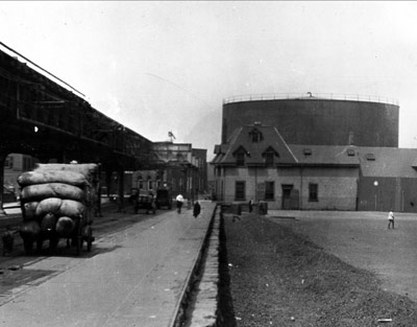

The schedule was tight. Jell was a company financial officer, not an engineer, yet he supervised the project for USIA. Construction ran through the closing weeks of 1915. Contemporary and later accounts describe night work and pressure to finish before an incoming shipment. The important point is not that haste automatically produces failure. It is that haste changed what USIA was willing to accept as evidence that the tank was ready.
A water test was useful precisely because water is boring. It would have loaded the shell gradually, made leaking joints visible, and given the structure a chance to reveal trouble before the stored material was valuable molasses in the middle of a city. The six-inch test did almost none of that. It placed water only around the lowest portion of the tank. The steel much higher up never experienced anything resembling the hydrostatic loading it would see in service.
That omission did not remain an abstract defect in paperwork. Once molasses was stored in the tank, it leaked. Mark Rossow’s engineering case study, drawing on the historical record and later analyses, notes that children could collect the seepage in cans. Workers heard the structure groan and shudder during fillings. The tank was eventually painted a brownish red; later accounts describe the color as making the leaks less conspicuous. Whatever weight one puts on the paint story, the leakage itself is not folklore. It was one of the persistent signs that the shell and its joints were not behaving like a sound storage tank should.
There is a temptation, with evidence like this, to make everyone around the tank a prophet. They were not. A leaking riveted tank did not tell a passerby where a fracture would begin or whether failure was days or years away. Noise from a large steel vessel under changing load could be interpreted in more than one way. The tank also remained standing through repeated fillings. Continued survival is persuasive evidence in daily life, even when it is poor engineering proof.
The six-inch test is useful precisely because it requires no hindsight. Nobody in December 1915 needed to foresee brittle fracture, calculate a modern finite-element stress field, or predict a molasses wave. The immediate question was simpler: had a fifty-foot vessel been tested in a way proportionate to the load it was about to carry? The answer in the record is no.
What 1915 Engineering Already Knew
Just before 1 p.m. on January 15, 1919, the tank came apart.
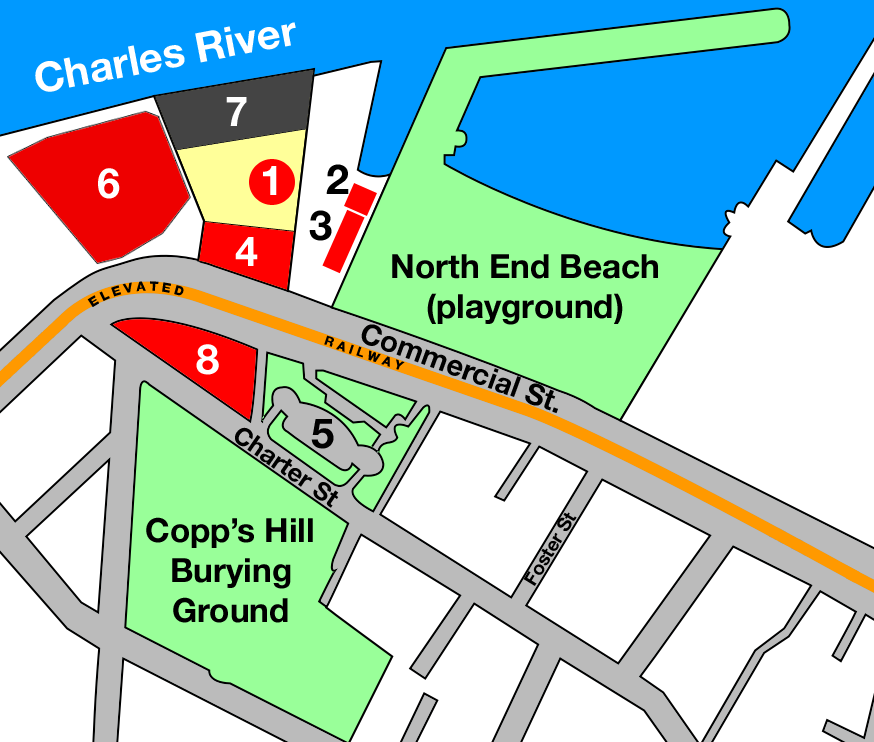

Witnesses described a prolonged rumbling and the sharp succession of rivets or metal giving way. Molasses struck Commercial Street, the nearby paving yard, houses, freight equipment, the Engine 31 firehouse and the elevated railway structure. The often-repeated figure of about thirty-five miles per hour comes from historical estimates rather than an instrument standing in the street that day, but later fluid-dynamics work found that a rapid initial surge was physically plausible. The important fact needs no dramatic embellishment: a liquid many times more viscous than water moved fast enough at first to carry people, timber and metal with it.

Ten-year-olds Maria Distasio and Pasquale Iantosca were among those killed. So was Engine 31 firefighter George Layhe. The City of Boston’s archival account places them among a death toll concentrated heavily among laborers and drivers working close to the waterfront. The scene photographed afterward is difficult to reconcile with the comic afterlife of the phrase “molasses flood.” Steel tank plates lie folded among broken structures. The elevated railway is visibly damaged. Streets are filled with debris and the remains of a working industrial district.
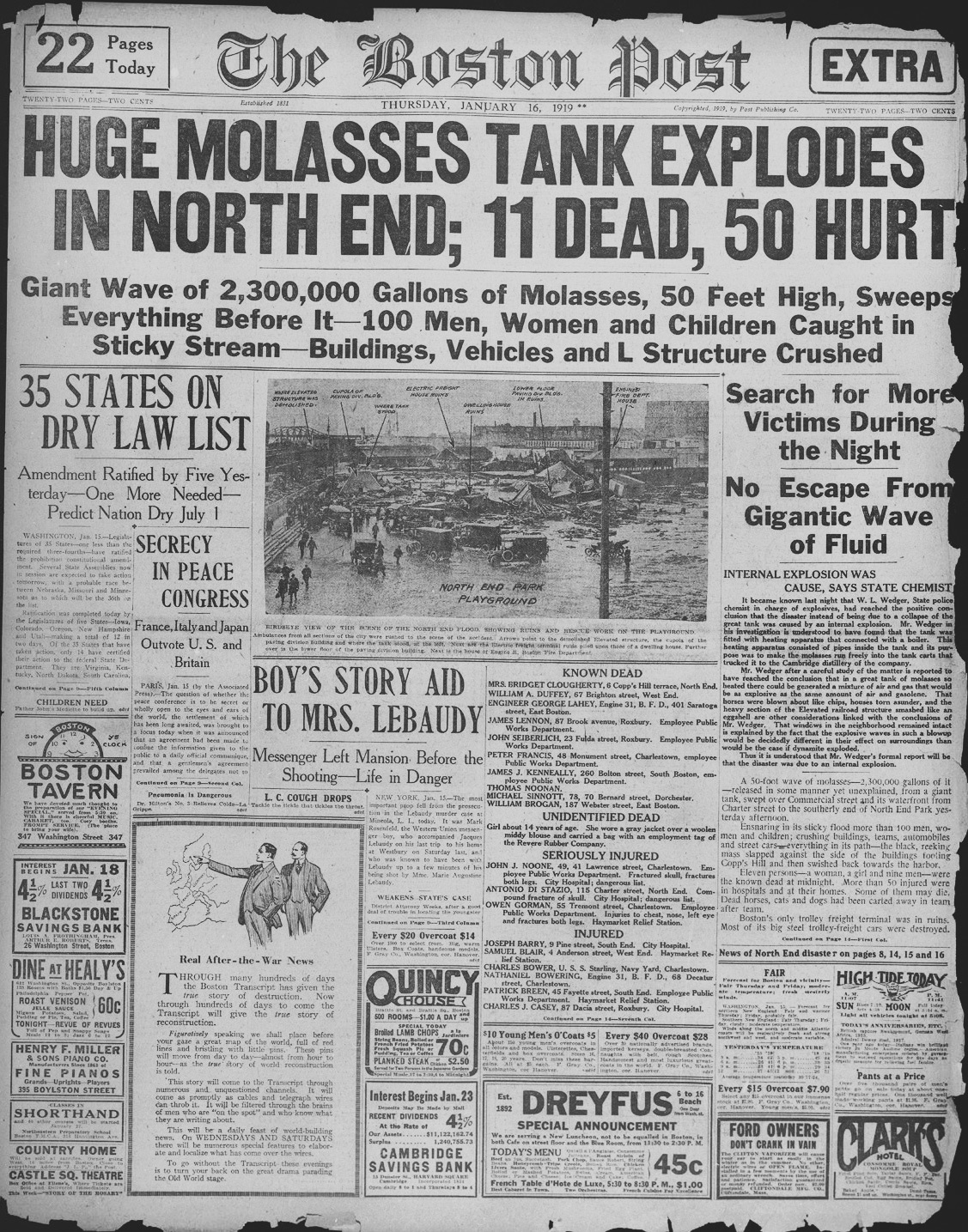

Rescue was a problem of material as much as distance. People who survived the first impact could be pinned by wreckage or trapped in molasses that became harder to move through as it cooled. Sailors, police, firefighters, Red Cross workers and civilians entered the site. Salt water from the harbor eventually proved useful in breaking down the residue during cleanup. For days, then weeks, the catastrophe migrated outward on boots, equipment and vehicles.

The legal fight lasted much longer.
More than a hundred civil actions were brought after the failure. Massachusetts Superior Court appointed attorney Hugh W. Ogden as auditor in the consolidated litigation; a later federal tax decision concerning Ogden records 118 lawsuits referred to him beginning in 1920. The hearings consumed years. The technical dispute became unusually elaborate for its time, drawing engineers and scientists into arguments over structural design, gas pressure, metallurgy and the possibility that a bomb planted by anarchists had destroyed the tank.
The sabotage theory was not invented from nothing. The United States had experienced bombings and threats associated with political violence, and USIA had reason to invoke that atmosphere. But an explanation can be historically plausible without being supported by the physical record. Ogden ultimately found the company liable. The defense had not established sabotage, while the tank’s design, construction and maintenance offered a large body of less exotic evidence.
In 2014, Massachusetts structural engineer Ronald Mayville returned to the surviving case material with tools unavailable to the original designers. The useful part of his analysis is not simply that it produces a more modern failure theory. It separates defects that could have been recognized with 1915 design practice from a material behavior that engineers of that period did not yet understand well.
The first category is substantial. Mayville concluded that the allowable stresses in the tank wall and riveted joints were too high by contemporary design practice. A 1913 machine-design text provided methods sufficient to check riveted connections; a computer model was not necessary to know that those details needed adequate margins. The low factor of safety, the joint design, the absence of a meaningful full-tank water test, and the failure to investigate persistent leakage and distress were problems that could be judged against knowledge already available.
Judging a 1915 tank with modern analysis would be easy and unfair. Excusing every defect because the tank was old would be equally misleading. The record allows a more precise split: some relevant standards genuinely changed later; some of the design checks USIA needed already existed.
Mayville’s reconstruction also focuses attention on the manhole in the tank’s lowest ring. The opening interrupted an already heavily stressed part of the shell. His finite-element analysis found particularly high stress around rivet holes near the top of the manhole, consistent with historical expert testimony and fracture evidence suggesting that a crack may have begun in that area. Repeated fillings could have enlarged damage until a crack reached a critical size.
That is a reconstruction, not a recovered film of the tank’s last second. Ogden had tens of thousands of pages of technical testimony and still did not pin the rupture to one microscopic sequence with modern confidence. The wreck itself had been torn apart, moved and examined under the pressures of a mass-casualty investigation and lawsuit. The strongest explanation today is more specific than the one available in 1925, but it remains an inference assembled from physical evidence, design calculations and later materials science.
What the 1915 Builders Could Not Yet Know
The steel adds a complication that the six-inch water test cannot resolve.
Mayville noted the low manganese content of the tank plate and the possibility of brittle behavior in the cold. Later materials data suggested a ductile-to-brittle transition temperature that could have been as high as about 59 degrees Fahrenheit for steel of this type. The air temperature on the day of the failure was around 40 degrees. In that condition, a crack in susceptible steel could propagate much more abruptly than engineers accustomed to ductile behavior might expect.
That mechanism was not well understood in 1915. Rossow uses the distinction carefully: the inadequate safety factor, rivet design, leaking shell and failure to investigate distress can be judged using engineering knowledge of the period; the ductile-to-brittle transition of this particular low-manganese steel belongs to a body of knowledge that matured later. If cold-induced brittleness was necessary to the final rupture, it adds a failure mode the original builders were poorly positioned to anticipate. If the design and accumulated damage were already enough, the tank may have failed without it. The surviving evidence does not settle that counterfactual.
The tank’s operating history makes the question harder rather than easier. Mayville found that it had been filled twenty-nine times but only four times to near maximum capacity. Two days before the collapse, another shipment brought it close to full again. A structure with an incipient crack does not have to fail the first time it is loaded. Each high filling can be part of the history of the fracture without providing a visible countdown.
Almost a century later, researchers took up a different problem: once the shell was gone, how the molasses had moved so fast.
In 2016, Nicole Sharp, Jordan Kennedy and Shmuel Rubinstein modeled the flood as a highly viscous spreading flow and compared the results with historical accounts. Their work helps explain a feature that sounds implausible on first hearing—that molasses could move rapidly enough to produce such damage. A deep reservoir of dense liquid suddenly released under gravity can have a fast leading surge even when the fluid is viscous. Temperature then changes the behavior further. At winter temperatures, viscosity becomes especially sensitive to cooling. The molasses that escaped the tank did not keep one convenient consistency from rupture through rescue.
That research is important, but it answers a different question from Mayville’s. Fluid dynamics helps explain the movement after containment was lost and why rescue became so difficult. It does not turn warm molasses into proof that fermentation burst a properly designed tank, nor does cold weather erase the design deficiencies documented in the structural record.
The same caution belongs in the legal legacy. The molasses cases are widely credited with strengthening expectations for engineering review, permitting, inspection and professional responsibility, and Massachusetts institutions still present the flood as part of that history. It would be too neat to say that one 1925 report created modern construction regulation. Engineering licensure, building codes and professional review were already developing. What the Boston litigation supplied was an unusually large public record of what could happen when a major industrial structure sat between private practice and weak external review.
Today there is a historical marker near the site. Its brief text does what markers have to do. It compresses years of construction, leakage, litigation and later engineering into a few sentences about a tank that “exploded under pressure,” structural defects and temperature.


The archival record is less compact. It contains photographs of the tank before the flood and steel folded across Commercial Street afterward. It contains the court files that forced witnesses to explain who designed what, who inspected what, and what people heard from the tank while it was in service. Modern engineers can add stress concentrations and brittle-fracture behavior. Fluid dynamicists can make sense of the moving molasses.
The six inches belongs earlier than all of that. It is not the cause of the flood by itself, and a full water test cannot be claimed with certainty to have prevented the disaster. A test can miss defects; a vessel can survive one full load and fail later. What the six-inch test establishes is narrower and harder to explain away: before the tank was trusted with a fifty-foot column of liquid, the evidence used to call it ready reached only a little above its bottom joint.
Sources & Further Reading
- Hugh W. Ogden, Auditor’s Report in the consolidated Boston molasses cases (1925). Primary legal and technical record for the liability proceeding and contemporary engineering findings.
- Dorr v. United States Industrial Alcohol Company, consolidated hearing transcript (1920–1924). Primary testimony on construction, testing and the tank’s operating history; held by the Social Law Library in Boston.
- Ronald A. Mayville, “The Great Boston Molasses Tank Failure of 1919” (2014). Modern forensic structural and metallurgical analysis of the tank, riveted joints, manhole stresses and steel behavior.
- Mark P. Rossow, “The Molasses Flood of 1919 and Other Ethical Failures in Engineering.” Engineering case study used for the construction/testing history and the distinction between period-knowable defects and later fracture science.
- Nicole Sharp, Jordan Kennedy and Shmuel Rubinstein, “In a Sea of Sticky Molasses” (2016). Fluid-dynamics work on the post-release flow, viscosity and temperature behavior.
- American Physical Society, “January 15, 1919: Physics and the Boston Molasses Flood.” Institutional summary of the modern fluid-dynamics research.
- Burtis S. Brown, “Details of the Failure of a 90-Foot Molasses Tank,” Engineering News-Record, May 15, 1919. Near-contemporary engineering description of the failure.
- City of Boston Archives and Records Management, “100 Years Ago Today: Molasses Crashes Through Boston’s North End.” Municipal archival account used for casualties, named victims, rescue, cleanup and image provenance.
- Stephen Puleo, Dark Tide: The Great Boston Molasses Flood of 1919 (Beacon Press, 2003). Deeply sourced narrative history, especially useful for the six-inch test reconstruction and litigation chronology.